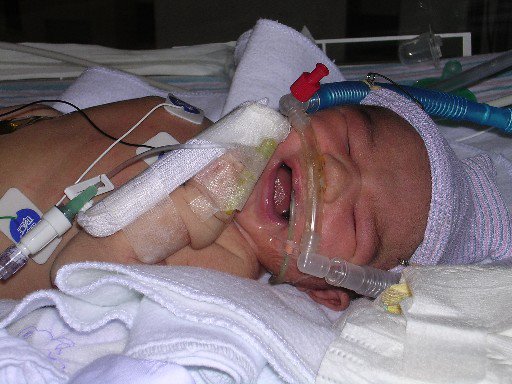
Thursday, February 22, 2007

Three words...


Tonight, I turned around and looked at Avery. She looked back at me and mouthed three sounds that sounded like "I love you." She then blew me a few kisses. I was absolutely floored. She has never done anything like that before. She has smiled, she has hugged me but she has never voiced "I love you."

I have probably told her 3940830948 times that I love her. For her to initiate the same words back to me was nothing short of pure love. I guess this is a small sample of what God must feel when we express our love back to him.

When is the last time you expressed your love for God? When is the last time you simply said "I love you" to God?

This reflection may not be what I talk about at seminary every day but the profound truth behind this experience outweighs all the volumes of books that I have read and more.

Wednesday, February 21, 2007

Image of God and Small Groups

I can't even begin to count the number of times I have heard this, "God is a God in community and therefore as humans created in God's image we are made for community." The line of thinking behind this statement is that God is one God in three persons who are eternally in relationship in what Christian's call the Trinity. The description of humans, male and female, created in the image of God has garnered a variety of interpretions. For many small group ministries, the theological foundation for small groups is the notion of "God in community" and therefore we are 'wired' for community.

I have to admit that I have harbored skepticism every time I have heard this interpretation of the image of God and humanity's desire for relationship. I haven't been able to put my finger on it until recently. My main skepticism stems from the fact that I do not believe that this goes far enough. Are small groups only supposed to be meant to be "in community" for themselves? I can already hear the quick response of small groups do service projects both inside and outside the church community. This is true but does that find its foundation in "God in community."

I believe that the Trinity is more than simply "God in community." My guess is that everyone would say that they agree with that statement but I want to draw out a specific idea. My understanding of the Trinity doesn't start with trying to diagram or mathematically posit the relationships between the Father, Son and Holy Spirit apart from what is revealed in Scripture. I have heard many try to liken the Trinity to water (one substance) with three forms (ice, water, steam) but one of the many problems with this approach is this view starts with human thoughts about physical entities as opposed to what is revealed in Scripture.

Starting with Scripture, the Triniatarian relationships are revealed in the Bible as the Father sending the Son and the Father and the Son sending the Holy Spirit and the relationships between them. What is the purpose of this sending? There are many reasons but the primary reason is for God to rescue humanity from sin (salvation) through Jesus Christ and then to establish his people as the church through the Holy Spirit. From there, the church is sent into the world to participate in God's ongoing mission of reconcilation until Christ comes again.

Small groups are gatherings of individuals by God for community but ALSO to be sent out in mission to whomever God puts them in contact. The foundation for this understanding isn't a desire for more service projects but the very nature of God as a God who sends and accomplishes his Word (which does not return void). This Word is Jesus Christ who embodies the reconciliation between humanity and God and we are gathered together as groups (small groups, local churches, the entire body of Christ) to accomplish this mission.

The next time you hear someone say that we are wired for relationships because we are created in the image of God and God is a "God in community," ask yourself or the speaker, "What do you see as the purpose of that community?" If the answer falls somewhere in the arena of fulfilling God's unique mission for that community in its specific time and place then I believe a fuller picture of the meaning of community has been considered.

Tuesday, February 20, 2007

Greatness

There are few great individuals in the world. I knew one and she was my Aunt Dorothy. Aunt "Dottie" was an inspiration to more people than I can begin to count. She died last night after a long struggle with a series of complications in her body. I just took an hour to type whatever came to my mind about this amazing woman. The one thing that I will share here is that she inspired me years ago to jump from my first job at a medium-sized consulting firm to a start-up company. She told a story about how much her, my Dad, and the rest of their siblings had to fight in Chinatown in NY City to flourish and provide for their families. I do remember her mentioning how they had to take risks to make things happen. I don't remember the exact words she said but I remember thinking "I also have that DNA inside of me and I have a responsibility to own up to that and take risks in my life." I was reminded today by reflecting on her life just how fast life goes and how little time I have to own up to what God has given me to do. Aunt Dottie owned up to her responsibilities and she will always inspire me to own up to mine.

Monday, February 19, 2007

Busted...

I have a habit of pointing out patterns that I find in presentations by speakers. This applies to preachers, teachers, seminar leaders, etc. I wrote my top list of repeated phrases a few months ago in a blog post. Phrases like "painting in broad strokes" and "unpack" made the list. In fact, I decided just for fun (my kind of ridiculous fun) to use those two phrases (back to back) during my chapel sermon last week.

My habit of pointing out things in sermons came back to bite me. Familiar words from Jesus in Mark 4:24 say "Consider carefully what you hear," he continued. "With the measure you use, it will be measured to you—and even more."

My measure - pointing out specifics in a sermon

Yesterday, I preached a sermon at my home church and I included what I thought was a throw-away line in the middle of the sermon. I said that salt is "what most of us relate to making food tasty or high cholesterol." I didn't think much of the line. I just wanted to put in a transition to the actual use of the term salt in Matthew 5.

A person pointed out to me later in the day that in fact salt causes high blood pressure not high cholesterol. My initial, internal defensive response was "is it that big of a deal that I said high cholesterol? is that the only thing you heard in the sermon?" Later on, after reading Mark 4:24, I reflected on the fact that my measure of pointing out specific parts of a sermon came back on me.

I am now starting to realize that all of my criticizing of things over the years in the church (poor leadership, specific sermon points, etc) will now be pointed at me as I enter full-time ministry. Writing a sermon, leading a church, doing anything as a full-time pastor is more difficult than I realized when I was a person who showed up on Sunday morning and had a lot of time to point out the problems without offering solutions...

Wednesday, February 14, 2007

Taunting...

One of my favorite moments during the day is when my cell phone rings and I get taunted by a friend. Oftentimes, a friend from Virginia will call to remind me that Virginia Tech is superior in some fashion to UVA. I have some other friends who like to remind me of how the New York Mets are not a real baseball team. I have others who like to simply take jabs at me. The list of friends who call me like this isn't large but I can count on numerous calls throughout the week.

Today, I received that type of phone call from a different person. This person happened to be from a potential church where I may be called to serve. He decided to call me in order to taunt me about the weather that we are experiencing here in Princeton, NJ (cold, icy, ridiculous) as opposed to his location. I never would have thought to put "phone taunting" on my list of desired aspects in a church but I now have that on my list!

Monday, January 29, 2007

Building a church...

Some updates have been made to my blog. I have been absent. I apparently haven't had any thoughts as I go... Of course, that is not true but I have been keeping them to myself. A lot is on the horizon as I seek out where God is leading me and my family.

Tuesday, December 05, 2006

Leadership from a different angle

1 Thessalonians is at the top of my list of favorite books in the Bible. I am biased because God gave me the greatest small group community in the history of small groups (Fairfax, VA - 1999-2000) and we studied that book during our time together.

My co-leader (Rob) and I saw clearly how Paul's relationship with the Thessalonians revealed to us how we should care for our small group. I kept a list of ideas along these lines that I now use for small group training. The requirements for church leadership are often derived from the listings in 1 Timothy and Titus but I would also recommend reading through 1 Thessalonians for a deep well of ideas for considering leaders in the church.

I came across 1 Thessalonians 2:1-12 during my morning lectionary reading and I ended up praying for the following prayer based on its content:

Lord, shape me into a leader of your church, I ask that you form me into a leader, proclaimer of your gospel, and caregiver that is like Paul as seen in 1 Thessalonians 2:1-12.
I ask that I consider those to whom you send me as brothers and sisters (v. 1),

that I dare to share the gospel in spite of strong opposition (v. 2),

that what I share not spring from error or impure motives or trickery (v. 3),

instead may I speak as one approved by God who has been entrusted with your announcement of God's reign, not trying to please people but God who tests my heart (v. 4),

that I may never use flattery or have secret greedy intentions (v. 5),

that I may never look for the praise of people (v. 6),

that I may be a gentle and caring shepherd who is like a mother to her children (v. 7),

that my love for my brothers and sisters would be so great that I would not only share the gospel but also my very life with them because they are so dear to me (v. 8),

that I may work so as not to be an excessive burden to anyone (v. 9),

that by God's grace I would be a holy, righteous, and blameless person among my brothers and sisters (v.10),

that I would deal with my brothers and sisters like a father deals with his own children, encouraging and comforting (vv. 11-12),

and that I would urge them to live lives worthy of God, the God revealed in Jesus Christ who calls each person into his kingdom and glory (v.12),

may I be this leader, encourager, and caregiver as seen in the apostle Paul as he follows his Lord and Savior, my Lord and Savior Jesus Christ - who lives and reigns with the Father and the Holy Spirit, one God, now and forever, Amen.

Wednesday, November 29, 2006

Like old times...

I really enjoy being online and feeling connected to the world. I took that for granted during my 6 years of work in the information technology where I would be online all day long. I didn't realize how much being a parent and having school work would disrupt that connection.

I do have a 'job' here at the seminary that allows me to experience that again. I work as a lab assistant in a computer lab and I get paid for writing stuff like this. The main difference between this job and my past jobs is I get paid a LOT less for basically doing the same amount of work.

Either way, that doesn't take away the fact that I enjoy having multiple email accounts open, this blog site, other blogs, my facebook account, my myspace account, and instant message sessions all going at once.

I should probably return to reading and doing my school work...

Tuesday, November 14, 2006

Foggy Perception...


I have received a couple of questions regarding this rarely (if ever) updated blog. I often have ideas to post but the transition from my head to the blog has not been a habit.

Today, I offer a picture of my life in the past year. My second daughter has slept through the night 3-4 times in her first full year of life. Last night was one of the "highlights" of this magnificent run of waking up. I went to bed early (9 AM) due to a head cold and woke up around midnight when she woke up. I was unable to fall back asleep due to being wide awake but I eventually fell asleep near 2:15 AM. 20 minutes or so later, she woke up again. I was unable to go back to sleep until 5 or 5:30 AM... I slept for 3 hours. I had a total of 6 hours of sleep but there was a 5 hour up/down period in the middle.

I guess that is why I have been a little out of sorts this past year. I wonder what it will be like when I can experience the world through the eyes/mind of a full night's sleep. Until then, I will continue to exist with a foggy perception of reality...

Friday, September 29, 2006

Give this guy a chance...

I am on a mission. I am always on a mission (those who know me can witness to that statement). I am currently in a theology of John Calvin class and one of my goals is to meet the real John Calvin. The term "Calvinist" evokes a wide range of responses from both those inside and outside the church, both those in the Presbyterian church(es) and those outside. Unfortunately for theologians, they are often branded with a short phrase or label that biases those who would otherwise learn from their writings, meditations, sermons, and lives of devotion to Jesus Christ. For Calvin, of course, he is associated with predestination.

I have the opportunity (yes, I view it that way) to hang out Calvin this semester. Darrell Guder encouraged me to view my class on the theology of Lesslie Newbigin last year as a time of mentoring by a theologian. I am taking the same approach to my time with Calvin (and Karl Barth in an independent study).

I was refreshed by Calvin's definition of piety. He said "I call 'piety' that reverence joined with love of God which the knowledge of his benefits induces." (1.2.1) What a great source for a prayer? "Lord, grant me the grace to have a reverence joined with a love for you."

I was also reminded of God's provision for me and my response when Calvin wrote "For until a person recognizes that they owe everything to God, that they are nourished by his fatherly care, that he is the Author of their every good, that they should seek nothing beyond him - they will never yield him willing service." (1.2.1) (bold added by me)

I am a stubborn guy. What would it look like for me to "yield him willing service" every day? My prayer life will be marked by an admission that I owe everything to God and that I would like to seek nothing beyond him.

I invite you to consider hanging out with Calvin and meet this man of God who reflected on the things of God beyond one subject (predestination). I am looking forward to seeing how he points me to Jesus Christ in the coming months and beyond.

Friday, September 22, 2006

New semester, Final year

My final year at Princeton Theological Seminary is here. I feel like I am in the classic back-and-forth where I feel like I just got here AND I feel like I have been here forever. My faith has changed in the past 2 years in many ways. I have come to some new places through wrestling with ideas that I didn't even have on my radar a few years ago. At the same time, I have seen how wrestling with potentially faith-wrecking ideas has brought me back to the firm foundation that the Lord Jesus Christ has been building for the previous 28 years of my life. That is why I sensed the Lord leading me to Princeton Seminary. I can now see more clearly the theological spectrum and I have a better sense of how different individuals and groups emphasize different parts of the Christian faith. I now feel more confident (properly confident to quote Lesslie Newbigin) than ever with my starting point being Jesus Christ as the Word of God revealed and his work in and through his sent church into the world.

I enter this year expectantly. I am most looking forward to seeking out conversations with those with whom I may disagree. I need to learn how to disagree with respect and gentleness. I also know that I haven't had one conversation in my life that hasn't shown me how I tend to push others away from me when I perceive that they think differently than me. I have missed out on some great discussions and life stories.

Let's see what happens. God-willing, I will post some thoughts as I go this year again. I disappeared for the summer due my internship in a hospital. My classes this semester are:
1. The Social and Ethical Implications of the Synoptic Gospels
2. The Theology of John Calvin
3. Atonement
4. Introduction to Education (audit)
5. Independent Study on Karl Barth's volume IV / 3.2 on the vocation of humanity and the sending of the church by the Holy Spirit.

I'd love to hear from anyone via a comment if you happen to journey onto this blog in the coming months...

Monday, August 28, 2006

Rare Event... shedding some tears

I have to admit that I shed some tears watching something tonight. I can honestly say that I have only cried in less than 5 movies in my life (and one was the Lion King!). I don't know if it is 10 weeks of CPE + 2 weeks or Ordination Exam insanity but tonight I shed some tears watching the end of an episode in Season Four of 24 (2 AM - 3 AM) - when Jack forces the doctors to work on the Chinese guy as opposed to Audrey Raines' husband...

This post has nothing to do with anything but I had to share this with someone...

Sunday, June 25, 2006

Gold's Community Church


I was talking to friend about his perspectives on his church. He mentioned how he felt that most individuals at his church belonged because that is what people did in that town. He gave numerous examples of what this looked like in the form of stories of those he encountered each week. If he hadn't stated that he was talking about a church, then I could have easily substituted Gold's Gym (or any other workout facility) in place of the church.

Is that what the church is supposed to be, another Gold's Gym? If so, then the future generations would rather go to Gold's... that is exactly what is happening. I will write some specific ideas on this in the coming posts. This one has been brewing for awhile.

Saturday, June 24, 2006

Proof or Story?


I have encountered no less than 10 sermon series, seminars, or pamplets on the Da Vinci Code. Initially, I was on the bandwagon (what is a bandwagon anyway?) that saw this as a point of connection with those who do not consider God or Christianity in their daily lives. My question now, however, is have Christians missed the point by focusing on logical proofs that seek to respond to every single point made by Dan Brown in his novel? In other words, are Christians asking the wrong question? I believe that they are. The question that I do not hear being asked is what does the success of the Da Vinci Code reveal about culture and the role of narrative in relating truth? In other words, what does the success of the Da Vinci Code reveal about today's consumer culture and how methods are used to reach it with a message?

One thing is certain, Dan Brown composed a compelling story and many have read it. What would have happened if Dan Brown selected a different medium for his material. If Dan Brown published a study with a point-by-point analysis of Mary Magdalene, then would he have sold as many copies as the Da Vinci Code? Absolutely not!

The irony is that Christians have responded to the novel as if he composed that very study. In other words, Christians have missed the point. I believe that the Da Vinci Code has exposed the church's weakness in sharing the most compelling story - the story of God's love for humanity in the life and work of Jesus Christ. Dan Brown told a story, Christians have responded with point-by-point counter-proof. Going forward, I believe that Christians are called to bear witness to the compelling story that God loved humanity, even though humanity didn't care at all about God, and sent his Son to make a way for us to be known by God and know God and to experience life in the way of Jesus. As we replace that story with point-by-point lectures that give 3049304983408 reasons why the Bible is true, then I think Christians are missing an opportunity to respond. Even better, Christians are missing an opportunity to share THE compelling story (that story by the way has outsold the Da Vinci Code this year)...

Blogger death

The best way to kill off a mediocre blogger (me) is to have an unsuccessful post. I just spent 30 minutes writing up some thoughts on how the church has missed the point with its response to the Da Vinci Code. I attempted to post but I lost my internet connection AND the content of the post. For someone who has been posting every 2.65913 weeks, that is DEATH...

Thursday, June 08, 2006

Interfaith conversations


I continue to notice a pattern in "interfaith" conversations and settings. The pattern is this - more often than not, interfaith equals no Christian references. I attended an interfaith prayer service today and I anticipated a mix of prayers and faith perspectives. Instead, I witnessed a list of references to every faith besides Christianity. A few Psalms were included in the prayer service but there was an obvious omission of any New Testament references.

Why does this pattern exist? Many would try to cite that Christians have taken advantage of their majority status to push back other faiths. Is this completely true? My observation is that Christians have often subscribed to a guilt complex that is shaped by Christianity's connection with colonialism and anything else that is related to the forcing of the Christian faith on others. I have a question in response to this connection. Why do other faiths fail to have the same guilt complex? Why is it that Christians always have to back out from asserting anything in "interfaith" conversations and prayer services?

I worked with numerous Muslims in my last software development job near Washington DC and I often had religious conversations throughout the day at places like the coffee maker. I had the opportunity to attend a Friday prayer at a local mosque with these friends and I received numerous insights from the experience. One of my closer friends was open to seeing the commonalities between our faiths but the majority of others had little to no interest in that kind of 'dialogue.' They made it clear that they did not have any form of guilt complex for the uniqueness of their religious claims.

Am I the only person who notices the pattern of Christian references being absent from "interfaith" conversations? Or am I one of the only individuals who is willing to point it out?

Sunday, June 04, 2006

Tale of Two Cities


3+ weeks have gone by since I finished up my second year at Princeton Theological Seminary. I have had a refreshing time with family and friends. I feel completely "detoxed" from the year and I can see how much God taught me this year through my classes and my relationships. A lot has happened this year.

Two weekends ago, I had the opportunity to go on a road trip with two friends (with the same name = Corey). I mistakenly thought that trips like this one were not possible after having 2 kids... We went to church at Presbyterian Church at New Providence on Sunday morning and then headed into NY City. Little Italy, China Town, a walk across the Brooklyn Bridge and then a subway trip led us to Shea Stadium for the Mets/Yankees game. It was freezing but the game and the crowd kept everything heated up. I love New York. I was born 20 miles from the city and its rhythms are built into my being. The intensity of the crowd was everything that I had anticipated. I would never bring my 3 year old daughter to a game like this one due to the profanity and constant fights but I took in the craziness with a smile. The Mets won and that made it even better...

We left from the Shea around 11:30 and drove up to a state park in Sturbridge, MA and had our tent set up by 4 AM... Around 10:30 AM, we woke up and found our way into a freezing cold lake to wake up. A grease-filled Cracker Barrel breakfast and drive led us to Boston where we hit up 2-3 pubs before the Red Sox/Yankees game. We arrived at Fenway early and stood near the Green Monster seats (hence the picture). As we talked, I heard someone yell "Heads up!" and then a baseball came flying by my head. I fought off another fan for the ball and took into possession my second official American League baseball. Fenway Park was incredible but the fans were a major disappointment. This was supposed to be the "most hate-filled rivalry in baseball" but I couldn't tell that from the slight chatter that marked the crowd volume all game long. The number of standing ovations at the Mets/Yankees game had to be near 50. The Yankees/Red Sox game featured 1. The boos for Jonny Damon lasted a mere 2 seconds and nobody seemed to care when Curt Schilling had 2 stikes on a batter. It will take a lot for someone to convince me that Red Sox fans are passionate after what I witnessed that night...

We returned to the camp site by 1 AM and talked over a cigar until 3 or 4 in the morning, woke up at 6 AM and drove south back to Jersey. I was exhausted but it was the perfect kind of exhaustion - one that was caused by a series of memories that only God can provide with close friends.

Saturday, April 22, 2006

Baseball Liturgy


I haven't posted in a LONG time and that reflects a life governed by family and school responsibilities. In an ideal world, I would post 3-4 times per week. I should be posting again now that I am entering finals period because this is a great forum for me to work out ideas and fight off writer's block!

Last night, I had the opportunity to go to Yankees Stadium to watch the Yankees LOSE to the Orioles (note - the picture above is the exact same vantage point of my seat). I am an avid Mets fan (they do exist) and every Yankees loss is a Mets victory. I have to admit that I enjoyed watching Hideki Matsui strike out looking with the bases loaded to end the game. My point in posting, however, has nothing to do with the actual game.

At the game last night, I experienced what I will call the liturgy of baseball. A baseball game at Yankee stadium is a religious event and the worship experience is marked by liturgy. The meaning of liturgy is literally "the work of the people" and the term is most often applied to what occurs in 'high-church' Christian worship gatherings. I experienced Yankee liturgy last night.

Let me explain. The "work of the people" included a wide variety of practices. First, the rituals associated with a baseball game are evident. Everything from how you order peanuts from the person going up and down the stairs to the clapping that occurs when the opposing batter has two strikes in the count. I even witnessed a "worship war" over the use of the wave at Yankee Stadium. The guy in front of me started yelling "Hey, that $%@#" is for Shea Stadium not for this place." It appeared that this guy had a clear sense of what was appropriate for the Yankee "denomination". Second, there is a leader in the liturgy of baseball. The PA announcer, who has been with the Yankees and NY Giants for many years, is revered and he has an expected and characteristic way of moving the game along by announcing hitters and pitchers. Third, the means by which 'saints' are recognized was evident as the crowd automatically gave Bernie Williams a standing ovation. Fourth, the 'sanctuary' is laid out with worship in mind, especially the area dedicated to Yankee greats out beyond the bullpen. Finally, the overall participation marks the liturgy because every person is involved from start to finish with the experience. These marks of baseball liturgy may not apply to every baseball stadium but they definitely apply to Yankee Stadium.

I found myself praying the following "Lord, what would it look like for these Yankee fans to dedicate even 10% of their energy toward worshiping what they ultimately long for - to be known and to know God through Jesus Christ." That prayer will be discussed at another time in another post but I wanted to put that out there for more thoughts.

Have you ever experienced a liturgy (work of the people) like I experienced last night?

Sunday, March 19, 2006

Painting with a BROAD BRUSH


How many of you have heard the phrase "paint with a broad brush"? Or perhaps, you have used this phrase yourself. How do phrases like this make it into our every day speech?

I have noticed that there seems to be a "phrase of year" that is tossed around Christian circles. Most likely, we hear these phrases from a notable speaker and then we decide to incorporate them into our sermons, teaching materials, and classroom "astute" comments...

What other phrases like this one do you hear repeated...?

Here are some of the ones that my friends and I have noticed (categorized by year).

1999 "You need to find a way to get plugged in"
2000 "We are meant for me than simply eating and taking up natural resources"
2001 "You can't build a bridge from Beijing to New York overnight but..."
2002 "We need to be transparent, authentic, open, vulnerable, INTO-ME-SEE (intimacy) persons"
2003 "Let me unpack this for you"
2004 "What earth am I here for?"
2005-06 "I hate to paint with a broad brush here but all evangelicals are X"

Alright, 2001 is one that I made up and used in countless meetings during my software development days. I can list a parallel list from the information technology world but I will spare you the debates between "notes" and "minutes"....

Am I only the one who hears this highly predictable, overused statements???

The Chinese Titanic


The PC(USA) requires a psychological evaluation for the ordination process. My experience last week was a very positive one. A question arose from the session regarding my Chinese background. The counselor asked why my grandfather left China.

The story of how my grandparents met is a Chinese titanic story (except the boat didn't sink). My grandmother and grandfather met on the boat from China to New York City. My grandmother was in the lower class level of the boat while my grandfather was in the upper class. At the mealtime, the lower class section was served rice and vegetibles while the upper class section was served steak. My grandfather decided to sneak down to the lower class section and he met my grandmother during the meal.

The question still remains, "Why did my grandfather leave China if he was in the upper-class?" I asked my Dad this question tonight and he shared some more of my family story. My great-grandfather was already in the United States (his reason for coming is unknonw besides economic opportunity, the U.S. was termed the Gold Mountain by the Chinese). My great-grandfather owned chicken markets (there were obviously no Wegmans back then, the chickens were killed on the spot and served 'fresh') and made significant money. He was able to pay for his children to come over and they came over in the upper class section. My grandfather lived in the Caton region of China where, at that time, a majority of the economy was agricultural and unpredicable.

My grandmother's parents were in the United States too but they were not as well off economoically. She came over and worked in laundry facilities to make money. My grandfather and grandmother continued their relationship after coming over to the "Gold Mountain." Stories like this are part of who I am and I need to be able to pass them on to future generations.

This post is part of that sharing to whomever may happen to come across it...

Thursday, March 09, 2006

Frozen in 1999 or not...


Music. I have been missing music from my life for awhile now. Music used to be as much a part of my life as food and sleep. I remember thinking that I would NEVER be the person who lost track of music trends but I have become that person. In fact, my music is forever frozen in 1999...

I have this theory that music taps into the deepest parts of our spirit and connects with our deep longing for relationships. The deepest possible relationship is with God but it is easier to focus on our relationships with others, especially romantic relationships. The zenith of my enjoyment of music was when I began dating Laurie and in our engagement time. Music connected with my longing for intimacy with another person and ignited my feelings.

Over time, especially with the arrival of two children and the subsequent destruction of free time, music disappeared from being a part of my normal day. Recently, however, it is making a comeback. Maybe it is because I am gearing up for the upcoming changes in my life as I can actually see myself serving in full-time ministry in the church. Music unleashes creativity and a hunger for life. This applies to God and others.

My late adoption of iTunes on my laptop and friends calling me an "old man" for being behind on the times has helped as well...... Either way, the music is playing again!

Why is music so powerful?

Sunday, March 05, 2006

Preaching Marathon


I didn't run a marathon today but I feel like I did.

Today, I had the opportunity to preach three times at the Presbyterian Church at New Providence(http://www.pcnp.org/sunday/1.html). I was given the sermon title "The Great Gamble" as part of a 4 week series titled Living Beyond Myself. The experience was more than I could have imagined. I didn't anticipate learning new aspects about preaching but that is exactly what happened..

Preaching is hard! Preaching is especially hard when a person has to preach multiple sermons in one morning. A few specific lessons came to mind today. First, preaching without a manuscript truly opens up opportunities to connect with the congregation. Second, never never never underestimate the fatigue associated with preaching multiple times in one morning. Third, it is impossible to preach with conviction when thoughts are not clear in my mind (this relates to the first two lessons). The first sermon at 8:15 AM included the positives of all three - connection to the listeners, energy, and clear thoughts/conviction. The second sermon at 9:30 AM included some moments of fatigue that led to fuzzy transitions and reduced conviction. The final sermon at 11 AM was a brutal struggle in my mind to keep pushing forward due to fatigue. I could sense that my conviction disappeared at points when I couldn't think as clearly.

Overall, my personal critique is similar to singing groups who know their mistakes when the listeners barely take note of any mistakes. No matter what, today was a big step forward in living into my forming identity as a pastor. I loved every second of the experience even if I was exhausted in the end.

Wednesday, March 01, 2006

Imitating what?


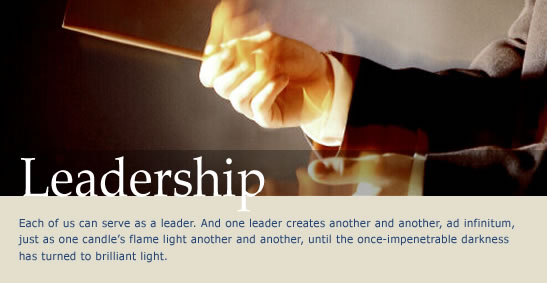
Leadership.

This picture is similar to the pictures that I saw at information technology companies where I worked for 6 years before coming to seminary. Posters like this one were in the hallways and were supposed to inspire great leadership.

Leadership is a money-maker. A person cannot even begin to count the number of leadership books that are out on the market. One trip to Barnes&Noble will expose a person to the vast amount of books on how to lead. I have read many of them.

I assumed coming into seminary that leadership would be a focus in my preparation for ministry. That hasn't happened. In fact, the opposite has happened. I have been taught, both directly and indirectly, to automatically question all forms of hierarchy. I have experienced how holding to a conviction only draws defensive responses from others who do not want their personal intellectual space threatened. I have not been taught or encouraged in the area of leadership during my 1 1/2 years here... Until today.

I am in a class that is studying the theology and life of Lesslie Newbigin. We recently read a chapter on his role as a pastoral bishop both in India and in Britain. One of my goals this semester is to be discipled by Newbigin as I study his life. This is in the spirit of 1 Cor 11:1 where Paul says "be imitators of me as I imitate Christ." There is no question that Lesslie Newbigin is a life worth imitating because he imitated Christ. Newbigin says that leaders in the church are to set an example for imitation - imitating Christ. A leader in the church is to be a fisherman, a shepherd, and first of all a disciple (to the cross).

Newbigin says that leadership in the Church always means "following Jesus in the way of the Cross, so that the whole Church may be enabled to follow and so, in turn, to draw others into the company of those who belong to Christ."

Maybe that is where I should be looking for 'leadership training' while at seminary...

Wednesday, February 15, 2006

Which one?


I posted a similar thought to this one on another blog in another life (few years ago).

Yesterday, I was leaving a Starbucks when I sensed that someone was following behind me. I looked over my shoulder to notice a person who had 340983098 things in her two hands. I simply waited a few seconds and held the door for her. She smiled.

Who do you think enjoyed the experience more, the one who served or the one who was served?

Tuesday, February 14, 2006

No Lower Point...


I just experienced perhaps the lowest moment of my life.

I visited my friend Neil's house in Maryland this past weekend on the way down to a ski trip. I hadn't seen his son (2 years 4 months) in almost a year. I arrived right when his son woke up from his nap so I had timed my arrival well. I went upstairs and Neil mentioned how his son loved The Wiggles (http://www.thewiggles.com.au - you have to see it and be a parent to be able to hang with the dancing insanity).

I grunted.

My response was based on my daughter's infatuation with the singing/dancing insanity. When Neil's wife opened the door, the boy came out. They said "This is Daddy's friend Jeff." The boy looked up at me, smiled and said "WAKE UP JEFF!!!" The guy in the picture above often falls asleep in the Wiggles videos and is greeted by that phrase. The little boy thought I was the Asian Wiggles guy named Jeff who falls asleep on the shows all the time... He called me a W I G G L E

Grace


Grace.

Grace is a concept or reality that mostly only makes sense when you encounter it firsthand. I had a conversation with a friend recently that brought me face-to-face with an aspect of the elusive term grace. One of my friends from my days in Virginia received a massive TV as a gift from his fiancee right after they got married. Yes, that seems like a grace-like story but that is not the real story for this post. A few years later (recently) he was lamenting the fact that he didn't have HDTV to watch a Redskins playoff game. At that very moment, he needed to adjust the TV and when he was near the back he noticed that the TV was HDTV enabled. He realized then that he had owned HDTV for 4 years without realizing it!!!

Grace.

One useful definition of grace is a surprise gift. That describes my friend's experience. Grace often is discovered or revealed in places where it already is present but we do not notice it or experience it. His TV had HDTV for years but he never noticed it.

Next, he discovered that he needed to order HDTV specifically for his TV but he didn't want to spend the money. So much for the great story... BUT when he walked outside and told a neighbor about his discovery, his neighbor responded with "I have an extra receiver!"

More grace...

Where do we miss surprise gifts just like this in life every day, moment? Check the back of your TV, maybe there is something you are missing too...

Monday, January 30, 2006

Great Clips TV?


I experienced the ever-increasing isolation of human beings from one another. I went to get my hair cut at Great Clips ($4.99 coupon!). I often say a short prayer before I get my haircut. The focus of the prayer is not my hair (which is quickly disappearing may I add) but for the person who is cutting my hair. My recent meditations on Scripture references that show the extent of God's love for humanity has reminded me of how much I need to love others in the simple, every day events - like getting a haircut.

I arrived at Great Clips, said my prayer while walking into the parking lot, put my name in to the computer, and then I was called for the CUT. I sat down and the first thing I noticed was a flat-screen TV on the wall. Broadcasting on the TV was "Great Clips TV". It was a visual equivalent to the repeated music at retail stories like Old Navy. I started a small conversation with the person cutting my hair and she seemed somewhat shocked. "Why would this person speak with me when Great Clips TV is on?" She saw the book that I brought with me (Kingdom of God by John Bright) and she asked me why I was reading the book. We had a short conversation because I don't have a lot of hair to cut but it was a conversation nonetheless. I could tell that the person appreciated being treated as a person and not a hair-cutting machine.

My prayer prepared my heart to be open to another person and the circumstances made the interaction even more striking due to Great Clips TV... Thanks to my friend Jon Chiu in Virginia for constantly reminding me to share the love of Christ in practical ways, even in the seat of a hair cutting place.

Sunday, January 29, 2006

Chinese New Year


Today is Chinese New Year - the year of the dog.

I was born in 1976 in the year of the Dragon. I am half-Chinese. My dad is first generation Chinese. My mom is a mixture of Welsh and German. I see myself as more a mixture of and tension between traditional Chinese and western American cultures.

I rarely speak about my mixed background in a serious manner. I was raised in a mostly caucasian, upper middle class town where there were only 2 Chinese individuals in my graduating high school class. I remember numerous instances of being mocked due to my Chinese background. I decided early on to avoid that side of my background in order to fit into my surroundings. My dad recently told me how he didn't force me to go to Chinese school so that I wouldn't be singled out as Chinese. For him, having me fit into my environment was important to him. My friends nicknamed me "one-third" because I was good at math, horrible at ping-pong, and never took karate (I took tai-kwon doe for a year but I didn't tell anybody). I avoided using chop-sticks until I went to college and I often intentionally opened my eyes larger in order to hide my chinese facial expressions.

One more story is that I remember making fun of my friend Danny Chang because he was Chinese in order to set myself apart from him and to further establish my caucasian identity. I was wrong and I wish that I could locate Danny and his family in order to ask for their forgiveness. That is what happens when a child is confused about his ethnic identity in an environment where the majority is caucasian. There are more stories than I can even begin to recount.

This blog entry will mark the beginning of more open sharing about my mixed ethnic background has shaped my view of God and the world.

Sunday, January 22, 2006


Life is full ups and downs. Right now, I can go 'on record' that I am in the zone. God, family, friends, and everything are in the proper focus and I feel more alive now than I have in a long time. I continue to realize how much I need times of silence and solitude in order to renew my perspective. My trip to the Holy Cross Monastery this past Tues - Thurs provided that exact opportunity. I know that returning to classes tomorrow will most likely be the thing that will get me off track and out of focus but for now I am in the ZONE!

Friday, December 23, 2005

Overlapping


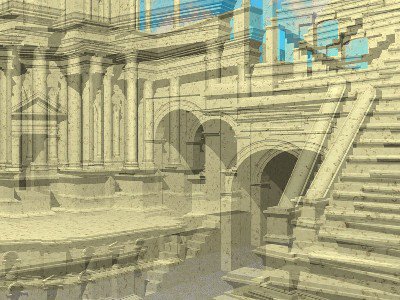
There is an overlap of pictures in this image. Both are real but one does not overcome the other in terms of being the "true" picture. My visual sense can focus mostly on one over the other but not completely. The overlap causes this visual conflict.

My recent study of the various interpretations of the kingdom of God brought me to this picture. In many ways, the Christian life is lived in this type of overlap. The overlap is not visual but, instead, encompasses all the person - heart, mind, strength.

The kingdom of God is referenced in two groups of sayings. On the one hand, Jesus message in the Gospels points to an imminent future apocalyptic expectation in Jesus' message (Mk 1:14-15; Mk 9:1; Mk 14:25; Mk 6:10). On the other hand, some sayings point to the kingdom as a present reality or experience in the world (Mk 4:1-33; Mt 11:2-6; Mt 12:28; Mt 13:16-17; Lk 17:20-21).

The tension between these two groups of sayings has led to various theories about the kingdom. 1. Jesus is viewed as an eschatological prophet who (like his contemporaries) expected and proclaimed the Kingdom as an imminent, eschatological event.
2. The 'present' or 'realized' sayings are authentic while the 'future' or 'apocalyptic' syaings are secondary.
3. Jesus was an eschatological prophet who proclaimed that the kingdom of God had been inaugurated in his person and ministry, but with a dramatic consummation in the future. (theories given in my Gospel of Mark class last spring).

The third provides a balance approach that holds the sayings in tension as we live in the overlap of the ages between the 'already' (Jesus' coming, death, resurrection, ascension, exaltation) and the 'not yet' (Jesus' return in power). I believe that the reign of God (kingdom of God) that is present in this overlap of the ages is real but often rejected in favor of a this-world ("realized") focus or other-world (future kingdom) focus.

What do we miss by assuming that this world is all that there is? What do we miss by assuming that God will not reign until Christ's return? We miss the present reign of God where the Spirit has been given and Christ reigns at the right hand of the Father now.

Paul attempts to answer this in light of his urging of the Roman church to offer their bodies as living sacrifices. The "renewal of the mind" of Romans 12:2 is a renewal toward seeing God's present reign as we wait patiently for Christ's return. We must not sleep because our salvation is closer than when we first believed (Romans 13:11-14)... Am I watching? Or do I think that I am left to my own devices to create the kingdom by human hands or do I think that this world is "going down" so I should bury my head waiting for Christ's return?

I'd rather watch and act "decently as those who live in the day" in service of God and others.

Kingdom of 'Heaven'


My recent posts are reflections that have come flooding into my brain after being able to step back from the unending onslaught of reading/papers. I continue to realize that a lot of my faith assumptions throughout my life have been based on interpretatations that I heard once and then kept without questioning.

My recent posts are swings of the pendulum to the far other side of the spectrum from some of my starting points. I have let the pendulum, however, swing back more toward the 'middle' after engaging the topics. My recent discussion on the end times and current living is another example of this type of pendulum swing. One example of a contributor to this recent swing is my understanding/interpretation of the kingdom of God. I have always been confused as to whether the kingdom was equivalent to heaven or "within me" or related to Jesus' reign overall. Like all theological vacuums, because I didn't fill it with it a theological reflection, something else filled it. In my case, I assumed that the kingdom was equal to heaven. My guess is that this interpretation is strong for many who glance at the topic because Matthew's Gospel uses the description "kingdom of heaven." This doesn't hold true, however, if the word heaven was used in order to avoid using the word God for a Jewish audience (or a Gentile audience interacting with Jewish communties). If Jews couldn't say YAHWEH, then the term God in "kingdom of God" would have been a sticking point in conversations about the nature of Jesus.

If we assume that the kingdom of God refers to heaven then all the references about God's reign are simply jettisoned the far future in another world. Does this capture the essence of Jesus' proclamation that the "kingdom of God is at hand (is near)"? My answer is No. I will write another entry soon on just why that is so. Until then, I wanted to initially capture the pendulum swing that I am undergoing on this very topic...

Thursday, December 22, 2005

Signing your name


I continue to actually listen to the questions that are being raised during my meditation on scripture and the readings from my studies. Admittedly, my brain is theologically drunk right now as I try to pray through and process the ideas that are challenging my faith and my understanding of the church. A recurring theme is "What you believe is how you live." In particular, I am exploring what this theme means in conversation with a person's understanding of what happens when they die and the emphasis that this understanding plays in the present moment.

What sources are intersecting on this theme?
1. My meditations in Romans - the real influence of apocalyptic thought in Paul's writing even in this epistle
2. Readings on eschatology in systematic theology
3. Brian McLaren's The Last Word and The Word After That
4. Previous experiences with those who pushed hard for premillenialism
5. My Christian experience as a conservative, evangelical, borderline (if not complete) fundamentalist.

The following argument is still underdeveloped but I want to get some thoughts out. The idea of how we live now according to what we know about what God has done and will do is seemingly basic. On one side of the spectrum, some live in fear of judgment because they are unsure if God truly has forgiven their sin. On the other side, some live without any fear due to the security of their salvation in Christ. What about the present time? What role does God play now in our lives as we live every day?

For most of my life, I have to admit that I have lived my life without any urgency for living out God's commands because of my "assurance of salvation." Is this what God intended by sending His Son to rectify the relationship between creature and Creator? How are we to live in this time between Christ's resurrection/ascension and Christ's return? What is the significance of the Son reigning at the right hand of the Father right now and the promised Holy Spirit at work right now? Is this life only meant to be a waiting room for the next where at best we view our life as a sanctification chamber? What does this type of relationship with God look like?

I had a conversation today with a friend about this very topic. During the talk, an idea that my friend Jon Chiu brought to my attention years ago came to mind. He posited that a 4 spiritual law approach to salvation without any other background was similar to having a person sign a Hallmark card with a generic note - "Hope your birthday's GREAT! Sincerely, Jeff" What is more sincere? 1. A personal note that is addressed to a specific person at a specific time based on a real relationship 2. A Hallmark card with only a name signed at the bottom.

A third possibility is a combination of both, a personal note that expands the generic statement/poem for that person. Either way, the most personal and important decision (to commit to being a follower of Christ) shouldn't be like merely signing your name and nothing else to a Hallmark card, should it? If it is, then the temptation to simply feel content that the card was sent will leave us without any urgency for cultivating that relationship further... right?

Excuse me...


I was in Panera Bread a few days ago and I witnessed a somewhat hilarious event.

A guy squawking on his cell phone with his cool new bluetooth device stuck in his ear. This guy, like many individuals who do not care about anybody else in the world, was talking loud enough for the whole place to hear his great sales pitch to his potential client. A woman sat down at the next table over and quickly became visibly annoyed. I watched a real live "boiling point" episode as she started to squirm. After a few mere seconds, she turned to the guy and said, "Excuse me, please shut the hell up!"

Here's my question, who was more inconsiderate?

Wednesday, December 21, 2005

Deconstruction


Deconstruction.

The classic statement about seminary (besides calling it 'cementary' due to the death of faith) is that seminary is a place where a person's faith is deconstructed. My response to that statement coming into my time at Princeton Theological Seminary was that I was not going to let "that place" deconstruct my faith. What I didn't consider was the possible advantage of deconstruction.

Questions like these were not on my already-defensive mind -
"How is my understanding of God limited?"
"What have others who have gone before me wrestled with?"
"How is my theology impacting my ministry and where does God want to deconstruct my assumptions and rebuild them?"

I have come to see how my faith coming into PTS was what many would consider too other-worldy in terms of salvation. If Christ died for our sins and we are justified, then what is the real incentive for caring about others in the here and now? Bonhoffer's Discipleship challenged me last year in this area and I continue to be challenged by my studies of Romans and eschatology in my system theology class. I will post more on these specifics as I process what I have crammed into my head throughout this semester. Overall, I see more clearly than ever that what we believe about God impacts how we live in the present moment as well as where we stand with God for eternity. It is both, not just one or the other.

Sunday, November 27, 2005


Admittedly, my recent entries have been short and bereft of theological insights. I have been in survival mode but I am seeing some light in my adjustment period to having two kids. This afternoon, my wife and I received a break from parenting and we went to see the new Harry Potter. Most people love Harry Potter. As for me, I fell asleep... Nothing against HP but I guess my body was able to relax and that led to an automatic shut-down. Hopefully that won't happen tomorrow in class....

Wednesday, November 23, 2005


This sign describes my world right now. I think that I went to bed around 3:57 AM last night. I was just woken up by a screaming baby at 3:57 PM. I looked at the window and I thought "Wow, daylight savings time is out of control! It is light outside at 3:57 AM!!!" These are not deep theological thoughts but these are the thoughts that I am having. I am reading some of my class reading but mostly my mind is occupied by the upsidedownness of life right now. Maybe Paul Tillich can correlate that existential question with a traditional belief in a new "baby-twilight zone" interpretative matrix... There is a thought...

Tuesday, November 22, 2005


Is this the graph that describes your day when you come to my blog? One of my favorite things to do is to locate crazy images through Google. I put in the word "thanks" in order to find a potential image for a lesson and I found a directory of hilarious pictures. This graph was one of them...

Monday, November 21, 2005

A Humiliating Experience (in the truest sense)


Every moment has been both a challenge and a joy since Avery came home from the hospital.

The changes in my life are innumerable and all of my daily/nightly patterns have been blown up. Intense life changes like this reveal how selfish I am. I can't even begin to count how many selfish, childish moments I have had in the past 2 weeks. I have realized how much I really do not look out to the interests of others (Philippians 2:4) but only to my own. I took some time tonight to step away from being a husband, a dad, a student, a friend, and everything else. I picked up The Way of a Pilgrim again and I read this "confession of an interior man leading to humility." I will write the first part in this post but the others may come later. These words capture much of what I feel often. It is a long read but it worth it...

A Way of a Pilgrim - pp. 113-115

Turning my gaze at myself and attentively observing the course of my interior life I am convinced, through experience, that I love neither God nor my neighbor, that I have no faith, and that I am full of pride and sensuality. This realization is the result of careful examination of my feelings and actions.

1. I do not love God. For if I loved Him, then I would be constantly thinking of Him with a heartfelt satisfaction; every thought of God would fill me with joy and delight. On the contrary, I think more and with greater eagerness about worldly things, while thoughts of God present difficulty and aridity. If I loved Him, then my prayer communion with Him would nourish, delight, and lead me to uninterrupted union with Him. But on the contrary, not only do I not find my delight in prayer but I find it difficult to pray; I struggle unwillingly, I am weakened by slothfulness and am most willing to do anything insignificant only to shorten or end my prayer. In useless occupations I pay no attention to time; but when I am thinking about God, when I place myself in His presence, every hour seems like a year. When a person loves another, he spends the entire day unceasingly thinking about his beloved, imagining being with him, and worrying about him; no matter what he is occupied with, the beloved does not leave his thoughts. And I in the course of the day barely take one hour to immerse myself deeply in meditation about God and enkindle within myself love for Him, but for twenty-three hours with eagerness I bring fervent sacrifices to the idols with passions! I greatly enjoy conversations about vain subjects which degrade the spirit, but in conversations about God I am dry, bored, and lazy. And if unwillingly I am drawn into a conversation about spiritual matters, I quickly change the subject to something which flatters my passions. I have avid curiosity about secular news and political events; I seek satisfaction for my love of knowledge in worldly studies, in science, art, and methods of acquiring possessions. But the study of the law of the Lord, knowledge of God, and religion does not impress me, does not nourish my soul. I judge this to be an unessential activity of a Christian, a rather supplementary subject with which I should occupy myself in my leisure time. In short, if love of God can be recognized by the keeping of His commandments - "If anyone loves me he will keep my word," says the Lord Jesus Christ (John 14:23), and I not only do not keep His commandments but I make no attempt to do so - then in very truth I should conclude that I do not love God. St. Basil the Great confirms this when he says, "The evidence that man does not love God and His Christ is that he does not keep His commandments."

Sunday, November 20, 2005

Agape or Not...


I have heard 3409830498304982 sermons/messages/talks/lessons on agape (unconditional love).

The reality of this is like many other aspects of Christianity in that it fades in and out of focus. All relationships include times where different aspects fade in and out. The addition of Avery Ruth to my family has opened my eyes in a fresh way to characteristics of unconditional love. Avery has nothing to give me in terms of approval or agreement. She may stop crying when I pick her up or simply make eye contact. Overall, however, she cannot "give" me anything. On the other hand, Cambria who is almost 2 1/2 years old can run to me and say "Daddy" or laugh at my stupid voices or make me feel good by saying "I love you Daddy." At points, Cambria's love is conditional and I can provide the thing to which she responds. I have been disturbed by how much I can sense in my spirit this difference. In fact, I can sense that I want to get a response from Cambria when I only get cries and some more cries (at this point) from Avery.

Doesn't this whole post show my selfishness? Isn't it amazing how God uses massive changes in a person's life to reveal just how ridiculous the human heart is when a sobering review is made of it...?

Wednesday, November 09, 2005


Avery Ruth Lee


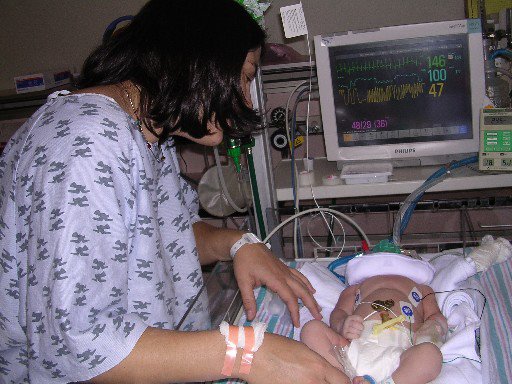
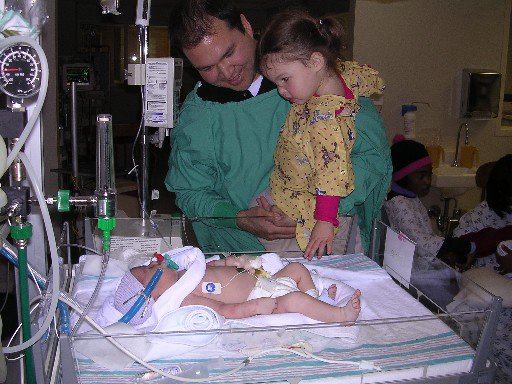
Avery Ruth Lee was born at 2:09 PM yesterday on 11/8/05 at 7 lbs 13 oz, 21.5 inches. She is currently in the special care unit but she is well on her way to being fully healthy and out of there. Laurie was nothing short of a warrior throughout the intense labor that was an intense 1 hr 15 minutes from hospital arrival until the birth. More pictures will be coming soon. We are grateful for everyone who was praying for us. The miracle of God's gift in the form of life, life somehow that comes from two people and looks/acts like them, has been realized again. Praise God!

Friday, November 04, 2005

Eating alone (at the Lord's Supper???)


Last night, I participated in an alternative Eucharistic worship service. The theme of the 'table of Christ' was repeated but the reality was there was no table (it didn't have to be a physical table). Each person stood up, went alone, received the bread and wine/grape juice, sat down, prayed alone, thanked God alone, confessed alone, and then there was a corporate prayer at the end.

Is the Lord's Supper or communion or the eucharist meant to be a lonely McDonald's experience?

Have you ever eaten alone at McDonald's? You get your food, sit down, eat quickly (maybe with something to read or now some McDonald's have TVs to watch). You are only concerned about yourself and what you are getting from the meal.

My recent experiences would lead me to answer affirmatively to the question "Is the Lord's Supper like a lonely McDonald's experience?". I have been challenged by a reading from Martin Luther where he reminded his readers that the Lord's Supper was not just for individuals. The problem is that many Christians approach the Lord's Supper only with a personal "me and Jesus" mindset in our individualistic world. I was taught as a kid to give thanks for Christ's sacrifice on the cross and to confess my sins while meditating on the cleansing blood of Christ. I still believe that this is a necessary part of the experience but is there more? If the purpose of the Lord's Supper is to thank and confess, then can't I do that at home or by myself somewhere else?

Here are some ironic observations that I (and I hope others) have made...
- we speak of gathering around a table but we 'eat and drink' alone in our thoughts
- we speak about the body of Christ but only in terms of what Jesus did for me while others are sitting right next to me (many of whom I do not know at all)
- we speak of Jesus dying 'for many' but again we only think about individual selves in the many

Paul says in 1 Corinthians 10:16-17 "The cup of blessing that we bless, is it not a sharing in the blood of Christ? The bread that we break, is it not a sharing in the body of Christ? Because there is one bread, we who are many are one body, for we all partake of the one bread." This passage is often overlooked in favor of the "do this in remembrance of me" passages. The focus in 1 Corinthians 10 includes the idea of the body of Christ as opposed to a single member of that body. Martin Luther challenged his readers to also consider the "other" that is sitting right next to you. We need to reconsider how to lift up the prayer "forgive us our sins" with "as we forgive those who sin against us."

Look around the room the next time you 'take' communion or the Lord's Supper or celebrate the Eucharist. Consider those who are around you. Pray for them. If needed, ask forgiveness and/or forgive others. Remember, we are the body of Christ, not a bunch of individuals... Remember, we don't want to look like the guy eating alone at McDonald's...


"I'll take a number 1 = bread with wine via dipping"
"I'll take a number 2 = bread with grape juice via dipping"
"I'll take a number 3 = wafer with wine from a single cup"
"I'll take a number 4 = wafer with grape juice in a cup"
"I'll take a number 5 .....

Tuesday, November 01, 2005

Catching a leaf


A subject that I come back to over and over is the challenge of living in the moment.

I have had a couple of experiences in the past 24 hours that are helping me to see how to actually do this. Yesterday, I went to Lake Carnegie near where I live in order to get a break from studies, baby-anticipation, and all the noise of life. I sat on a wall overlooking the lake and took a deep breath. I thought to myself, "This is living in the moment." What was different about that moment? I wasn't thinking about any upcoming school assignments or obligations to anybody. My only focus was on the cool breeze, beautiful trees, and honking geese. That was living in the moment.

Another moment occurred last night when my daughter was trick or treatin (is that a phrase a verb?). She came out from an apartment and said, "Daddy, I want to go to more houses!" She was enjoying simply receiving candy. I saw her joy and I paused. That was living in the moment.

Finally, I just went for a short walk. During the walk, I reflected on a sermon that I heard in theology class yesterday based on "For it is by grace that you have been saved." The sermon was by Karl Barth and at one point he focused on having a carefree approach to life that results from living under God's grace. He challenged the audience to ask for grace. I asked for grace on my walk. I asked for help in the area of living in the moment. A few minutes later I noticed a leaf falling. I grabbed it. I realized that if I hadn't been simply living in the moment then I would have missed that leaf. I wasn't thinking days, hours, or even minutes ahead.

That was living in the moment.

I need to be more open to moments like that. What "leaves" am I missing?

Yes, that ending sounded like a bad sermon ending but the question still stands... :)

Monday, October 31, 2005

Enough Time?


I just heard someone checking his voicemail when he was in the bathroom... I know that tend to multi-task in very creative ways but I haven't gone there yet. Do we really feel like there is not enough time so that we have to check our voicemail while going to the bathroom???

Sunday, October 30, 2005

Change in Perspective


I received a lesson on perspectives.

Daylight savings time was always welcomed. "Falling back" meant an extra hour of sleep and happiness. I received a new perspective now that I am a parent of a toddler. "Falling back" now means that a child who was waking up at 6:15 AM now wakes up 5:15 AM. That does not equal sleep and happiness... A new perspective on the same thing that I've taken for granted for over 28 years....

Wednesday, October 26, 2005

Blogging vs. Paper-writing

I often feel mentally paralyzed when I start to write a paper. The feeling is eerily similar to my experiences with computer programming during my undergrad time at UVa. I usually have the flow of the paper in my mind but I always have a difficult time launching into the actual writing. On the other hand, I do not feel that way when I click over to this blog and start typing away. Last year, I used this as a place to unclog my brain by writing out some initial ideas before I launced into writing an actual paper.

I am currently working on a Romans exegesis paper for Romans 12:1-2. The storyline for the paper is that rational worship is the key for renewing the people of God. These two verses come at a transition point in the letter to the Romans where the apostle Paul transitions from an exposition of the gospel of God to a section of exhortations for the newly formed one people of God. Paul began his exposition of the gospel in chapter 1 after describing it as the "it is the power of God for salvation to everyone who has faith, to the Jew first and also to the Greek." This gospel was everyone who has faith and opens the way for the one people of God.

Paul quickly moved to a picture of all humanity that is able to see God's invisible qualities but does not respond with thanksgiving or praise. The misplaced praise is instead funneled toward the creation as opposed to the Creator. The result of this idoltary is humanity's thinking became futile and it's minds became darkened. Paul lists the outcome of this darkened mind in the form of human behavior that degrades the body and lists of vices that result in a community marked by selfish behavior. The first 11 chapters of Romans show how all of humanity is in need of the gospel that Paul describes because, as he states in 11:32, "for God has imprisoned all in disobedience so that he may be merciful to all."

After a short doxology that affirms the riches and wisdom of the knowledge of God, the transition verses of Romans 12:1-2 are found. What does Paul accomplish with this transition? Paul asserts that rational worship, as opposed to the irrational worship found in idoltary, reverses the darkened mind and opens the way for the one people of God to discern God's will and live in a community marked by selfless behavior. This can only be accomplished by the mercies of God. These mercies are described in the righteousness of God depicted in the first 11 chapters. The one people of God, both Jews and Gentiles, who exist without the Torah and the temple cult now must offer themselves as living sacrifices in order to live as community that responds to God's grace. The following sections of exhortation (parenesis) only make sense in light of the continual renewing of the mind found in rational worship.

The key words and phrases located in Romans 12:1-2 along with their uses in other parts of Scripture provide the foundation for this assertion.

therefore
mercies of God - II Cor 1:3, Hebrews 10:8
appeal
brothers (and sisters)
present - Romans 6:13; 6:16; 6:19
your bodies - Romans 6:6; 8:11; 1 Corinthians 6:20; Philippians 1:20
living sacrifices - Hebrews 13:15-16; Philippians 2:17; 4:18; 1 Peter 2:5
holy and acceptable to God
rational - 1 Peter 2:2 (spiritual milk)
worship - noun is in Romans 9:4; Hebrews 9:1; verb found in Romans 1:9; 1:25, Hebrews 8:5; participle (one who worships) found in Hebrews 9:9; Hebrews 10:2
do not be conformed - 1 Peter 1:14
this age - 1 Corinthians 1:20; 2:6; 3:18
changed in form - 1 Corinthians 3:18
renewal
minds - Romans 1:28; Ephesians 4:17-25 (similar to Romans flow); Colossians 2:18
approve - Romans 1:28; 2:18; 14:22; Philippians 1:10; 1 Corinthians 16:3
the will of God
good, acceptable, and pleasing


Let's see what happens when I actually put this in a paper that includes my thoughts as well as input from commentaries and articles...

This may be the most dry blog entry you have ever read or it may be the a launching point for your own study of the material. Either way, this is admittedly self-serving because I needed to get something out of my thick head so that I can write this paper before my second child is born (any minute now!)...

Saturday, October 22, 2005

Prayer of the Heart


I am learning more and more about the rhythms of my brain during my time at PTS. This year has proven to be a significant challenge with the combination of being a husband, a dad, a future dad of two (baby #2 is due in 2 weeks), a student, an intern, and sometimes a friend... I have been working through some energy management 'practices' with my mentor at PCNP but I am far from consistently practicing them (as I write on this blog when I should be going to sleep). One way that I have learned to relax is by a reading non-school book at night before I go to bed.

I decided to pick up a classic that I have heard about from numerous friends, mentors, and my wife - The Way of a Pilgrim. I was re-introduced to this book a few weeks ago when I led the Gathering @ PCNP in the Jesus Prayer (prayer of the heart most often associated with the Eastern Orthodox tradition). I decided to incorporate this prayer in my life, especially when I could sense that my body was being taken over by stress or anxious thoughts. The basic form of "Lord Jesus Christ have mercy on me" is prayed by praying the first part "Lord Jesus Christ" when inhaling and "have mercy on me" when exhaling. I started to do this as a means of the prayer of the heart. The longer version of "Lord Jesus Christ, Son of God, have mercy on me, a sinner" was introduced to me last year in Inquiring After God (TH 291) and I have used this longer version as well.

One quote from the book resonated with me when the pilgrim said in response to his time in jail, "All that had happened seemed not to affect me; it was as if I had watched someone else being treated. And when they flogged me, the Prayer strengthened and consoled me and I was oblivous to everything."

I haven't been jailed or flogged but I have experienced this sense of watching my circumstances from afar when I have experienced the peace of Christ in my life. I haven't sensed this recently but maybe as I jump into more times of the interior prayer I may start to experience the "peace that transcends all understanding" that I have often meditated on in Philippians 4:6-7.

Thursday, October 20, 2005

Water skiing and Preaching?


I thought about water-skiing today.

I haven't attempted to waterski in years. One of the first things that I wanted to do after learning to swim was to waterski. I was 5 years old then. I attempted to waterski for the first time at Young Life Camp at Saranac when I was 17 years old. I failed miserably! I remember the day clearly. I tried 3x and each time I fell over only seconds into the attempt. Unfortunately, I haven't tried since then.

Why did thinking about water skiing today? I shared my first sermon today for my preaching class and the feeling was similar to my water skiing experience. The excitement was there but it was accompanied by a lot of anxiety. My desire was for my anxiety to be translated into humility and some of that happened. At points in the sermon, I felt like I fell over in the water and wanted to give up. At other times, I felt like I was able to hang with the challenge. Overall, the ride was a humbling experience but one that I am ready to embark on again. Unlike waterskiing, I am not giving up! Maybe one day I will try to water ski again...

Anyone wanna go?

Saturday, October 08, 2005

More than an internship


I am currently leading a group of young adults at Presbyterian Church of New Providence (PCNP) for my field education internship. The opportunity goes way beyond an internship for me. I grew up in PCNP and now I find myself back at the church. The church has a completely different feel due to a new senior pastor and numerous changes to almost everything. I have been given the opportunity to lead the most challenging, in my opinion, group in the church - young adults. Young adults are overlooked and, to be frank, ignored in many churches.

Why? I think the real reason is because they are hard to "pin down." Another reason is I have seen that churches do not take them seriously because of their busy lives and lack of tithing. I definitely differ on the tithing aspect because I've seen that individuals in their 20s/30s are more willing than others to support the ministries where they see God at work.

Most churches have 'programs' for youth and for families with young children. The gap between high school graduation and the first kid is a big one. I feel called at this point to be a leader to help address this gap. I am convinced that God's upside down way of working in the church (taking the least and making them the greatest) applieis to this gap.

If anybody is actually reading this, then do you see this pattern in your church? If you don't go to church, then if you ever checked out a church, did you feel like this was true?

Wednesday, October 05, 2005

Postless blog?

Where are the posts?

I have heard this from some friends who have actually come to this blog. I am currently suffering from postless disease where I often know what I want to post but I rarely do it.

I have been in a valuable dialog with my senior pastor about energy management in ministry. I have been monitoring my daily energy patterns and I have noticed our posts like these definitely require energy. I believe that the energy is worth using especially since I need an outlet for the 30943049830948098 thoughts that I have every day. I can definitely say that I am "theologically drunk" again this year after having a good summer to sober up through reflection.

In that light, I will start to use my creative energy here again and this will not be the postless blog that has existed. My meditations on Romans passages, reflections on Christology, exposure to viewing the church missionally, reworking of my teaching/preaching method, and humbling experiences at Presbyterian Church at New Providence will be here soon.

I may be writing to myself but isn't that what most blogs are anyway... This is a greenhouse for ideas and my desire is that friends and others will post comments as I work through ideas.

Monday, September 26, 2005

Grace isn't for holding

Two of my classes intersect quite often this semester. The one class is a Greek interpretation class of Romans and the other is a introductory course on missional theology. The intersection makes sense since Romans is considered by many to be the greatest description of the gospel and missional theology involves mission (the sending).

I will write more about the specifics of missional theology as I continue in my learning but the main piece that has struck me is how much the Scripture is composed of missio Dei (God's mission) - God's self-revelation as the One who loves the world, God's involvement in and with the world, the nature and activity of God, which embraces both the church and the world, and in which the church is privledged to participate (Transforming Mission by David Bosch, p. 10).

Now back to the intersection. A few days ago, my Romans class focused on Romans 1:1-17. Romans 1:5 states (NIV) "Through him and for his name's sake, we received grace and apostleship to call people from among all the Gentiles to the obedience that comes from faith."

The point that jumped out from considering the entire letter to the Romans and the themes of sending (among others) included in it was found in the combination of grace and apostleship. For Paul, in this verse, one does not exist without the other. Grace is not for our keeping. Grace is coupled with apostleship or the sending out. The rest of verse 5 states why we are sent out - to call people from among all the Gentiles...

How much do I focus on God's grace without focusing on the accompanying responsibility of being sent to the world? Grace isn't for holding.

Friday, September 23, 2005

Righteousness of God

I love meditating on Scripture because I always realize the assumptions that I bring to the Bible and then God challenges me to consider if they are true. One example of this type of challenge is my view of righteousness.

I just spent 3 days interacting with Romans 1:1-17. I read it in English, I translated the Greek, I did an inductive study, I formed my own provisional conclusions, I read one commentary, I attended a lecture on the passage, and then I read another commentary. The foremost challenge to my assumptions going in was to my view of the righteousness of God as being for the individual person who stands condemned by God. This is one aspect of the righteousness mentioned.

I started, however, I ask the following questions:
- What is the difference between holiness and righteousness?
- How did the readers of Romans in the 1st century understand righteousness?
- Based on the content of the letter, is this righteousness solely for the individual or is there a larger view that I am missing?

The first question came because I have always read Romans 1:17 as the righteousness of God was revealed so that the unrighteous individual received God's righteousness so that he would be saved and not condemned. Is this the total picture of righteousness that Paul is stating? Am I simply using righteousness as a synonym for holiness where I am now considered holy by the work of Jesus on the cross?

God's righteousness, as viewed by Israel, could be defined as God's right actions based on what they knew about God as revealed through their Scripture and the covenant. The people of God, Israel, had confidence (faith) that God would do the right thing based on his convental relationship with the people.

How does this fit into Romans 1:17? Does the righteousness of God (or from God) mean more than what I stated earlier? I now believe that the righteousness of God that was revealed in Christ Jesus is God's right action in responding to evil and sin in the world. This is what we would 'expect' God to do based on his promises, both to the Jews and to Gentiles.

Maybe the righteousness of God is aimed more at the cosmic struggle between good and evil more than the individual salvation of a soul. Yes, the individual salvation based on faith in work of Jesus Christ on the cross is part of this picture but maybe it isn't the starting point. Maybe starting with the cosmic view is where Paul wants us to start as opposed to the individual "what's in it for me" view that I have often brought to Scripture.

Praise God that the righteousness of God is revealed in the gospel!

Thursday, September 22, 2005

I'm Lovin' It

I had to adopt the McDonald's slogan for how I am feeling right now. I'm Lovin' It!

Those words are what my entire being felt yesterday as I finished a study session at Starbucks (yes, I am a Starbucks guy and not a Small World guy). I had just finished reading parts of assignments for 3 of my classes.

Last year, I thought to myself, "Why am I here?", regarding Princeton Theological Seminary. I had come to this seminary for a myriad of reasons and one of them was to interact with a postmodern world instead of simply setting it up and shooting it down from a conservative seminary. My experience matched my desire for that interaction even though I didn't feel comfortable most of the time (is being comfortable ever a good thing?). I did, however, question whether I wanted to spend the next 2 years of my life in the land of extreme discomfort. I questioned and prayed about leaving this place.

I know that I made the right decision to stay here. My conclusion is not based on the fact that I am taking courses this semester that appeal more to my high view of Scripture and more conservative positions, even though that definitely is a major factor. I said "I'm lovin it!" yesterday because I know that I am experiencing exactly what I wanted to experience here at PTS - interacting with a postmodern world. Even better, I now see that my faith, that has changed since I've been here, has been rooted in legitimate places and I understand somewhat that there is a place for me in the leadership of God's bride, the church...

I'm lovin it!

Hear the words... They are true today (let's see if they remain true in coming months)

Saturday, September 03, 2005

Motivation?


The majority of questions, for those who are outside the situation, surrounding the crisis in Louisiana (and beyond) have not centered on the classic question of "Why would God let this hurricane hit New Orleans?" Instead, a majority of questions have focused on the chaos in the city - looting, shooting at rescue teams, convention center compound, the abandonment of the elderly and children.

The questions come from a wide variety of angles (spiritually, politically, "what the heck is going on"-ally). I cannot even begin to count the amount of questions that I have heard or that I have thought on my own over the past 4 days. I thought about trying to write about one or more of them today but I will, instead, list off as many as come to mind. I will say that the first one has been the one that has been pulling at my soul the most.

- What is the motivation for an individual or a group to be selfless in a situation like the Katrina crisis when all worldly incentives (money, job security, prestige, etc.) are removed? More specifically, why would a police officer stay on staff to help when his/her whole world has also has been destroyed and there is no financial incentive to stay perform his/her duty? This question arose when I heard that almost 40%-50% of the police force simply left duty. This question also applies to every example of looting and the other examples that elicit a "how can people being doing THAT" response.

- Where is the prophetic Christian voice to address the real problem of sinful, selfish actions? I envision millions of paralyzed Americans watching 24-hour news reports about the rapes, shootings, and looting. They are thinking, "How can this happen here and why is this happening?" Columbine, 9/11, and now post-Katrina atrocities all clamor for a voice to speak into the situation. The voice must provide a true Bibilical response that starts from a Biblical worldview that includes how we got to where we are (the Fall) and how we can have hope in Jesus Christ (redemption). This redemption applies at the individual and system levels of society.

- Has the media's portrayal of the U.S. military around the world impacted how our own citizens reacted to the U.S. military in New Orleans? In other words, have the non-stop reports of the U.S. military's failures in Iraq eroded the average U.S. citizen's view of the military to the point that shooting at a U.S. military helicoptor wasn't a big deal in New Orleans?

- What has the Department of "Homeland Security" been doing in the past 4 years? If a hurricane can cause this much anarchy then what will a dirty bomb or a nuclear bomb do to this country?

- How did a hurricane transform a major U.S. city into a place that includes scenes similar to the scenes of Iraq and Rwanda? The references to rapes are the most horrifying.

- What is are the similarities and differences between Katrina and 9/11? Why is my feeling similar but different?

- How much should I watch 24-hour news in order to understand the situation and have a genuine sense of compassion for the people who are suffering? At what point, should I turn it off and find other ways to deal with crisis from afar besides consuming endless reports?

- Is the fear resulting from Katrina rooted in humans facing the reality that they cannot control nature? Humans constantly want to control nature in order to create a predictable, safe space in which to live. How has Katrina's strike at this very assumption of safety and control increased the fear of Americans for the future?

There are at least 3904834098309 more questions but these are the ones that came flying off of my typing fingers right now. If anyone reads this, then I'd love to hear about which question you have asked the most (whether the question is in my list or not).

Friday, September 02, 2005

Strangly Silent...


I have been strangely silent about the disaster in Louisiana because I, like the rest of us, have been trying to wrap my head around what has happened. I came across this picture while viewing a set of picture repositories about Katrina. This picture was taken 1-2 days before Katrina arrived. The men were securing the tree from being blown over. They, like the rest of us, had no idea of the extent of the physical damage that would occur.

The other types of damage have had a lot deeper impact on both those who experienced Katrina first-hand and those who are experiencing the disaster via 24-hour news from afar...

On another note, why did these men think that they could secure the tree with the work of humans (tying it with a rope to the ground) as opposed to putting faith in the roots of the tree?